Technique 8 min read

Categories, minimums and performance

Aircraft categories A–E, ILS CAT levels, ILS variant letters, and RNP vs ANP — the fine print that decides whether you may fly an approach.

An approach plate is not a free pass: every procedure assumes a certain aircraft and crew. The categories below decide which minima column applies to you — and whether you may fly the approach at all.

Aircraft approach categories (Vat)

  • CAT A — under 91 kt: C172, DA20 and other light singles.
  • CAT B — 91–120 kt: faster pistons, light twins, many turboprops.
  • CAT C — 121–140 kt: the airliner band — A320, 737-700 (the heavier members — A321, 737-800/900 — are CAT D).
  • CAT D — 141–165 kt: 747, 777, 787, A350-1000 and fast military jets.
  • CAT E — 166–210 kt: rare, mostly military.

The number behind the letter is Vat — roughly your approach speed at maximum :

Vat=max(1.3VS0, 1.23VS1g) V_{at} = \max\left(1.3 \cdot V_{S0},\ 1.23 \cdot V_{S1g}\right)

The greater of 1.3 × stall speed in landing configuration (V_S0) or 1.23 × stall speed at 1g (V_S1g). Some plates restrict categories entirely (" A,B,C" at London City keeps fast jets out of the 5.5° approach). In the sim, read the column matching your actual speed.

ILS categories — how low is allowed

  • not below 200 ft, ≥550 m (or visibility ≥800 m). The default everywhere.
  • CAT II — DH 100–200 ft, RVR ≥300 m (FAA: 1,200 ft). Autoland or approved HUD required.
  • CAT IIIA — DH below 100 ft or none, RVR ≥175 m. Autoland mandatory.
  • CAT IIIB — DH below 50 ft or none, RVR below 175 m but at least 50 m. Rollout guidance included.
  • CAT IIIC — no DH, no RVR: full zero-zero autoland. Almost no airport is certified for it.
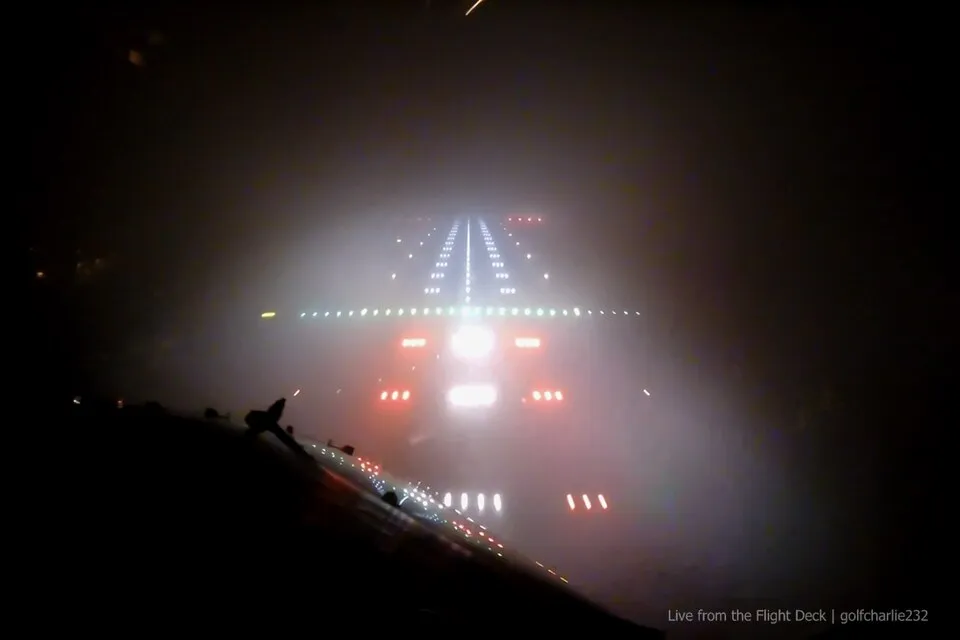
CAT IIIA approach in fog
What CAT III actually looks like: a real CAT IIIA autoland with the runway appearing at minimums. Weather that day: BKN001 OVC002, RVR 1000 m. Photo: golfcharlie232, CC BY-SA 4.0, via Wikimedia Commons

Why the title says ILS X, Y or Z

When several procedures serve the same runway, the plates get suffix letters — starting at Z and working backwards: , ILS Y, ILS X (then W, V…). The letter itself carries no meaning: the variants differ in their , feeder routes or notes. FAA charts use the same convention (e.g. "ILS Z 28" vs "ILS Y RWY 28"). Always brief the specific lettered plate you are flying — two "ILS" to the same runway can go-around in opposite directions.

RNP vs ANP

(Required Navigation Performance) is the accuracy a leg demands — "RNP 0.3" means the must keep the aircraft within 0.3 NM of the path 95% of the time. (Actual Navigation Performance) is the accuracy your FMS computes it is achieving right now. The rule is simple: ANP must stay at or below RNP; if ANP exceeds it, the aircraft alerts and the safe answer is a go-around.

RNP AR — Authorization Required

approaches use curved RF legs (radius-to- ) to thread through terrain — Queenstown being the classic example. "AR" means aircraft certification and crew approval are mandatory. In the sim this mostly reduces to: does your add-on fly RF legs properly, and does the FMC show RNP/ANP monitoring.